Click here to read this article in Arabic
A couple of years ago, I heard a sermon by Pastor Chuck Swindoll titled, Autopsy of a Dead Church. It resonated with me so deeply that I felt compelled to write about it, convinced that its message would resonate with many others as it did with me. While some of what is contained in this article builds on what Pastor Swindoll outlined in his sermon, most of what you are about to read originates from my own experience inside one of the most traditional and perhaps oldest churches in Christendom—the Coptic Church of Alexandria, Egypt.
To provide context, I was raised in the Coptic Church, and like Paul of Tarsus with his Pharisaic roots, I was deeply entrenched in my church’s tradition and dogma. I was a well-respected deacon, a teacher of Coptic hymns, a Sunday school teacher, and occasionally a preacher. At some point, I even joined one of the many hymn institutes of the Coptic Church to further my knowledge of the church’s history, hymns, and rituals. I was even nominated to be ordained as a Coptic priest at one point! During the years I spent in the Coptic Church, I was zealous for its faith, heritage, and doctrine. I never joined a different church, and on the handful of occasions I attended another church, I always felt that what I had in my own church was better, more real, and more authentic. I also felt a sense of pride that the church I belonged to was more orthodox in its teaching, more faithful to the word of God, and historically closer to what the direct apostles of Christ taught and did. In short, I genuinely believed that what I had in my church was “the real deal,” while other churches were far less so.
How the Lord snatched me from that mindset—and ultimately led me out of the Coptic Church at age 43—is a story for another time. But for now, let me just say that, by the grace of God, I was freed from the spirit of religion that had gripped me for so long, and I now enjoy a truly personal and intimate relationship with my savior, Jesus Christ, the Son of God. My time with the LORD is no longer driven by ritual, but by relationship—not by practice, but by personal connection. This background is crucial to understanding both the burden behind this article and the reason I believe it is needed.
When I first heard Pastor Swindoll’s sermon, I was driving in my car. I was listening to his sermon on the radio. When I reached my destination, I could not get out of the car because I wanted to hear his sermon to the end. To say I was stunned is an understatement. Nearly every characteristic he described of a dead church mirrored what I had experienced in the Coptic Church. I was left wondering: How could a preacher who likely had never even heard of the Coptic Church describe it so accurately and vividly, as if he had attended it for years? At some point, I thought that he had identified the main characteristics of the Coptic Church and listed them in his sermon! More practically, however, I realized that if a pastor like him could list the characteristics of a dead church, and they all apply precisely to the Coptic Church, then it must be the Spirit of God who led him to list these qualities of a church he never attended.
What follows are five marks of a dead church—marks I believe apply not only to the Coptic Church I once knew but to many others. I share these thoughts with you not to criticize my (former) church or yours. Instead, consider them to evaluate your current or future church: Is it truly alive, serving Christ and advancing his kingdom by transforming the hearts and lives of its congregants, or is it serving its own interests and those of its leaders—a church, in the words of Revelation 3:1, “has a name that it is alive, but it is dead”?
1. A Church that Worships Its Past
Perhaps the most telling mark of a dead church is its subtle awareness of its own death! Nowhere is this more vividly expressed than in its profound attachment to its past. A dead church clings to its former glory so tightly that it seems to still live in it. This nostalgia often stems from the recognition—spoken or unspoken—that its present no longer reflects the vitality it once knew. Those who have no present to be proud of tend to live in their past! This lifeless church is prepared to defend its past at all costs against anyone who dares to question its accuracy, its authenticity, or its true significance.
This phenomenon is evident not only in a dead church but also in dead nations. Societies that were once at the forefront of advanced civilizations, when they fall behind and lack development and progress, tend to pride themselves on their history rather than on their present. As someone who grew up in Egypt, I have witnessed this reality firsthand. Once at the helm of the civilized world, but now firmly a “third world” country, all that Egypt (and the Egyptians!) have left to take pride in today is the fact that their ancestors built the pyramids more than five thousand years ago!
In a lifeless church, this frequently shows itself through the veneration of early church fathers’ writings, raising them to the same status as Scripture while disregarding revelations that the Holy Spirit, in his divine wisdom, may choose to impart on contemporary believers. These historical texts form the foundation for many doctrines within such churches, and members who reject these beliefs, which lack biblical support, are usually excommunicated.
While it may be edifying for a church or society to remember its history and take pride in past achievements, an unhealthy attachment to the past can be a hindrance. In fact, this first characteristic of a lifeless church is the root cause of the other signs of death. When a church (or society) is overly attached to its past, constantly looking over its shoulder, and excessively proud of achievements in which the current generation played no part, it becomes impossible for it to move forward, leaving it completely stagnant.
2. A Church that Refuses Change
Excessive attachment and love for the past inevitably produce a fear of change. To accept and allow change, one must be willing to let go, to some extent, of the way things were or currently are. For growth to occur, one must be willing to move forward, which inevitably requires leaving one’s current position behind. When a would-be disciple said to Jesus that he wanted to say farewell to his family at home before following our Lord, Jesus answered, “No one who puts his hand to the plow and looks back is fit for the kingdom of God” (Luke 9:62). Years later Paul expressed this spiritual principle when writing to the Philippians, saying, “But one thing I do: forgetting what lies behind and straining forward to what lies ahead, I press on toward the goal for the prize of the upward call of God in Christ Jesus” (Phil. 3:13–14). To Paul, this ability to press ahead was the hallmark of spiritual maturity and growth, for then he immediately follows up by saying, “Let those of us who are mature think this way, and if in anything you think otherwise, God will reveal that also to you” (Phil. 3:15).
I must clarify that the change I am referring to here is not a change in faith. As Paul states in Galatians 1:8–9, the faith once delivered must never change. What I have in view here is a change in practice or tradition—one that does not alter the core of what we believe. For instance, introducing musical instruments such as a guitar or piano into a Coptic liturgy was viewed by some as a form of heresy (this was a real case in the Coptic Church in recent years!). Yet this does not change anything the Bible teaches regarding the essentials of the faith. Nevertheless, even this kind of change would be fiercely opposed within a dead church.
Refusing to move beyond its past glory and what it believes was its “golden age,” this lifeless church will inevitably remain stagnant. Unlike Paul, it remembers what lies behind and refuses to move forward! A church that believes its past is all it has, or the best it has, will never be able to create a present that it can embrace and be equally proud of.
3. A Church Whose Leaders Are Lazy But Authoritarian
The leaders of a dead church are the guardians of its heritage. To guard their tradition against all attempts at progress, these leaders tend to exercise authority, lording over their congregants exactly in opposition to what our Lord said to his disciples—that they must not lord it over their brothers and sisters (Luke 22:24–27). This exercise of authority is often needed in order for them to silence those who differ in opinion or who question the church’s doctrine or its interpretation of the Bible. Their priority becomes, as they often put it, “guarding the faith,” instead of caring for God’s flock. This is when defending even non-essential doctrines takes precedence over the unity of the body of Christ, over saving souls, and over winning them to the kingdom of God. They forget that the ultimate aim of the faith is the salvation of souls! (1 Peter 1:9).
As the guardians of history, these leaders no longer feel the need to study, delve into God’s word, or pursue further learning—what I once called, “intellectual laziness.” To them, it is sufficient to regurgitate what others have taught them, especially higher-ranking church authorities, such as bishops and popes. Much of what they preach Sunday after Sunday is merely a repetition of what others have preached before them. Their sermons lack life, enthusiasm, and application. Their sermon preparation consists of listening to sermons by other “fathers” within the church on the same topic and taking notes.
4. A Church Whose Youth Are Neglected
With the leaders of this dead church always in the spotlight of its unappealing landscape, the youth in the church are often set aside and marginalized. The youth within this church are the first to see and feel its deadness. Full of life and vitality, the youth in nearly every community demand authenticity and realness. When missing, they are usually the first ones to leave, and when this dead church tries to hide its own deadness and patch the breaches in its character, young men and women can easily see through that insincerity. They simply have no tolerance for a lifeless church. They recognize the refusal to swap pretense for authenticity and a stagnant history for a vibrant present.
The inevitable result is that they often leave—and most do not return. While some of them may abandon this dead church for a vibrant one, sadly, many leave the church and abandon their faith altogether. Ironically, the very approach this stagnant church uses to safeguard its flock—by clinging to its past, maintaining authoritative leadership, and refusing to change—is exactly what drives away its younger generation—its future and promise!
5. A Church without the Great Commission
Preoccupied with preserving its past and exerting control over its congregants, a dead church has neither the interest nor the spiritual vitality needed to fulfill the very mission for which our Lord established it—evangelism. In my experience, some of the most indifferent leaders when it comes to saving souls are those at the helm of such churches. Although the Lord commanded his church to preach the gospel and teach the world all that he taught his disciples (Matt. 28:19–20), these leaders are more concerned with keeping their members from attending or joining other churches—especially those of a different denomination. Others focus on converting Christians from other traditions, aiming to win them over and bring them back to “the orthodox and upright faith”!
One of the things I personally noticed when I started attending the evangelical church—years before I left the Coptic Church for good—was its heavy focus on preaching and teaching the gospel to nonbelievers. This was something that I had never encountered in the Coptic circles. Many claim that the reason Copts do not evangelize is because they are “the persecuted church” in predominantly Muslim societies. But this is not true. Even when Coptic Egyptians migrate to other countries, such as the United States, Canada, and Australia, where they can spread the gospel, they still do not show any interest or expend any effort in preaching the good news to non-believers.
Years ago, I was on sabbatical in Alexandria, Egypt, where the Lord had called me to spend time reading and studying Scripture, just as Paul did in Arabia. As I was returning home from church one day during the early weeks of that sabbatical, I was able to extend a helping hand to a stranger in the street, who, it turns out, was a Muslim. When he asked me if I were also a Muslim—quite a common question in that part of the world—I responded by saying that I was a Christian. The man was touched by the fact that a Christian, whom he viewed as an infidel, stopped and helped him, stating that some Christians are kinder than most Muslims. My response was that we are not good or kind because we are somehow better people, but because our Lord Jesus, whom we worship, is the one who makes us that way. As he stated the Islamic position that Jesus is nothing more than a mere prophet, I began to expound the Scripture to him, explaining that Jesus is, in fact, the Son of God who is equal to God. I spent nearly forty-five minutes evangelizing to that man. I went home that afternoon full of joy and purpose for having witnessed to my Lord and Savior. But this is not the end of the story.
When I arrived at my house, I picked up the phone and called a friend of mine, who, like me, was deeply rooted in the Coptic Church. In fact, she was in charge of the Evangelical Committee of the Coptic Church in Egypt, which did not evangelize in Egypt (ironically) but sent missionaries to other countries, such as India, Thailand, and Singapore. I recounted this story in her hearing, overtaken by joy that I can still remember. Her response, however, was shocking. She reprimanded me for speaking to someone in Egypt about Christ in a public setting. She said that something like that should have been handled “with wisdom” and that I had put myself in danger of being reported and arrested. While her response was seemingly logical, I found myself saying to her: “Do you want to know the truth? I am glad that Peter and Paul were braver than you are. Had each of these disciples been concerned for their safety, trying to exercise ‘wisdom’ as you said, we would not have known today what it means to be a follower of Christ. This is why many are invited, but a few are chosen!” A couple of years later, I returned to the United States, but I still vividly recall that joyful afternoon.
Conclusion
In closing, let me remind you that our Lord Jesus did not come to this world to establish a system of doctrine or worship rituals. He did not die to deliver a creed or preserve tradition. He came to save—to seek and to rescue the lost, snatching souls from hellfire (Jude 23). His one command to the Church was clear: make disciples by baptizing them and teaching them to obey all that he commanded (Matt. 28:19–20). Even when the church feeds the hungry, shelters the homeless, or cares for the sick and destitute, all this must always serve the greater mission: proclaiming the gospel of salvation in Christ. What good is it to relieve people’s temporary suffering if we fail to minister to their eternal destiny? Likewise, what is the value of a church that prides itself on guarding “sound doctrine” but is too lifeless to tend to the spiritual needs of its people? A church may appear faithful in form, but if it neglects its mission, it has already died, even if it claims to be alive and well.
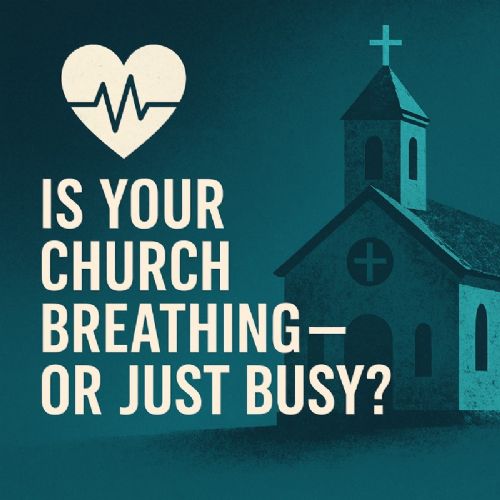
I titled this article, Is Your Church Breathing—or Just Busy?, but this is a worthy question to reflect upon as a Christian in your own life: Are you living for Christ, serving him, witnessing to others about him, and helping advance his kingdom? Or are you, too, just busy?—busy with what the Bible calls “the cares of life,” busy with career, family, and accumulating wealth. I encourage you to reflect on these questions, lest you be busy with what is temporal, ignoring what is eternal, and focused on what is transient, neglecting what is permanent.
If this blog encouraged you, share it with a friend. Click here to join my mailing list so you can receive my latest articles and resources directly into your inbox before they are published. You can also connect with me on Facebook or LinkedIn.